
“The most powerful thing in the world isn’t a weapon, a Devil Fruit, or even a dream. The most powerful thing is a story.”
I’m the kind of person who believes the best ideas show up when you least expect them.
One night in late March, watching the first episode of One Piece’s second season, I stumbled onto the perfect way to open this piece.
And it makes sense. If we’re going to talk about the power of stories, that conversation inevitably leads us to the people who create them and the people who work to get them in front of an audience — which is exactly what this is about.
As part of the Studio AYMAC team, alongside May, our producer, we’ve spent a decade working with stories — our own and other people’s — helping them find their audience, whether we produce them ourselves or connect the creator with larger platforms.
We’ve seen it all.
Projects with brilliant ideas that didn’t survive their first meeting. Stories with international ambition that fell apart at the first tough question. Talented creators who couldn’t explain, in two minutes, why their story mattered.
Not because they were bad projects. But because they weren’t ready.
And over time, that taught us something that now sits at the core of how we work: a story can’t defend itself. It needs someone behind it who can hold it together when the questions start coming.
The pattern we keep seeing
We currently receive two types of projects that rarely make it past the early stages of development.
The first arrives with cracks in the foundation. The story contradicts itself, characters shift without reason, and the tone can’t hold its own from the storyline to the synopsis. If there are five contradictions in ten lines, ninety pages of screenplay aren’t going to fix that — and chances are, we won’t get that far.
The second case is more interesting, and more common these days. These projects look solid on the surface. The premise, storyline and synopsis line up. The grammar is clean. The structure wobbles but holds. Everything points to a story being there…
…Until the conversation starts.
When we sit down with the writer, director, or whoever is representing the project, something shifts. The questions pile up. The answers get vague. And what looked like a well-built story deflates in three questions flat.
The problem isn’t the writing itself. It’s that someone took an initial idea and stretched it — filling pages without ever truly deciding what story they wanted to tell or where it was going.
And that matters more than it might seem, because not every idea is built for the same room. A good anecdote can become a short film or a miniseries. A real story — one with a defined conflict and fully realized characters — can become a feature or a series. Knowing which one you have isn’t about format. It’s about depth. And when a writer can’t explain that in a conversation, the question stops being about the project. It becomes: Does this story actually exist?
And at this point, we can’t ignore something that keeps coming up when we see these kinds of inconsistencies: artificial intelligence.
AI in screenwriting: clean copy isn’t the same as solid storytelling
Let’s be straight about this from the start. The problem isn’t using AI. The problem is handing it the wheel.
Using tools to write more efficiently, structure ideas faster, or explore different versions of a scene is completely fair game. We’ve done it. We do it. Chances are, you do too or you will.
But something starts to break down when the tool stops being support and becomes the author: the writing looks good on the outside and says nothing on the inside.
You can spot it right away. You read and read, and it feels like the text is going somewhere — there’s structure, there are important-sounding words. But when you finish, you can’t explain what it left you with. It’s like listening to a politician give a speech: a lot of noise, very little signal. The same idea dressed up four different ways, passing itself off as depth.
In a story, that’s a dealbreaker. Because what’s missing from the page will be missing from the conversation too. Characters end up hollow, conflict loses its weight, and narrative decisions have no real reason behind them.
Nobody reading a screenplay or listening to a pitch cares how it was written. They care whether it has something to say.
That gap — between a text that looks solid and a story that actually is — is exactly what we’re trying to identify when we evaluate whether to come on board a project.
In those meetings, the questions that come up aren’t trick questions. They’re the most basic ones anyone would ask before investing their time, money, or name in a story.
- Why does this character make that choice and not another?
- What’s really at stake?
- Why does this story need to exist right now?
If you’ve put real time into your story, none of those questions should catch you off guard. You’ll have already worked through them — with yourself, with trusted readers, across the many drafts you wrote before deciding to show it to anyone.
A strong pitch isn’t a summary — it’s the start of a conversation
When you’re looking for support in the development phase, you’re not just selling a script. You’re selling yourself and your team as the right people to see it through. And the first place you prove that is in the pitch.
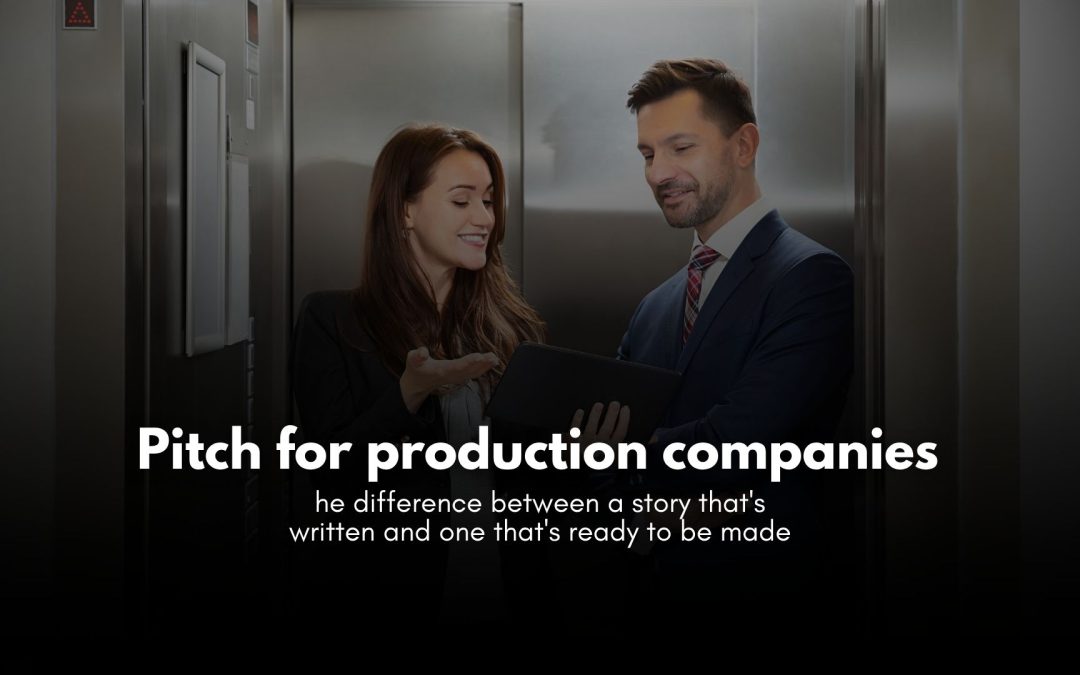
A lot of people confuse the elevator pitch with a summary. They think it means cramming the whole story into a short window — reciting the synopsis from memory or walking through every plot point before the other person can get a word in.
That’s not it.
The elevator pitch is exactly what it sounds like: the length of an elevator ride. Seconds, not minutes. And a longer pitch isn’t a monologue either. Both have the same goal: to answer three things clearly and in a way that lands.
- What are you telling?
- Why does it matter?
- What makes it different?
Not to explain everything. The goal is to spark something in whoever’s listening — so that when you finish, their natural response is to ask more.
And here’s the part most people don’t see coming: you have to be ready to answer those questions. Because if the pitch opened the door, what comes next either keeps it open or shuts it for good.
A pitch isn’t something you memorize. It’s something you build when you truly know what you’re telling. That’s what gives you the flexibility to read the room — adjusting the time and the words without losing the thread. And it holds up when you know your story so well that nothing they throw at you takes you by surprise.
What does a production company look for before coming on board your project?
As head of content, I’ve sat across from frustrated creatives — mid-rewrite, mid-iteration — who’ve said: “My story is perfect. I just have it all in my head.”
And at Studio AYMAC, we get that frustration. But a story that only lives in your head can’t go anywhere.
We’re not looking for perfect projects.
We’re looking for creators who know how to tell their stories — because at the end of the day, that’s what we do.
In this industry, the edge no longer comes from having the right tools or being able to generate ideas fast. It comes from knowing how to use those tools without losing the wheel. From being the one who decides, who builds, and who can defend every choice made along the way.
Developing a story doesn’t end when the draft is done. It ends when you can defend it.
And if you’re at that point, we’d love to hear from you.
Do you have a story in its initial development stage?
At Studio AYMAC, we can help you structure it with clarity and focus: from the One Page to transforming it into a solid market proposal.
Contact us and let’s talk. Your story deserves strategic development..
Comentarios recientes