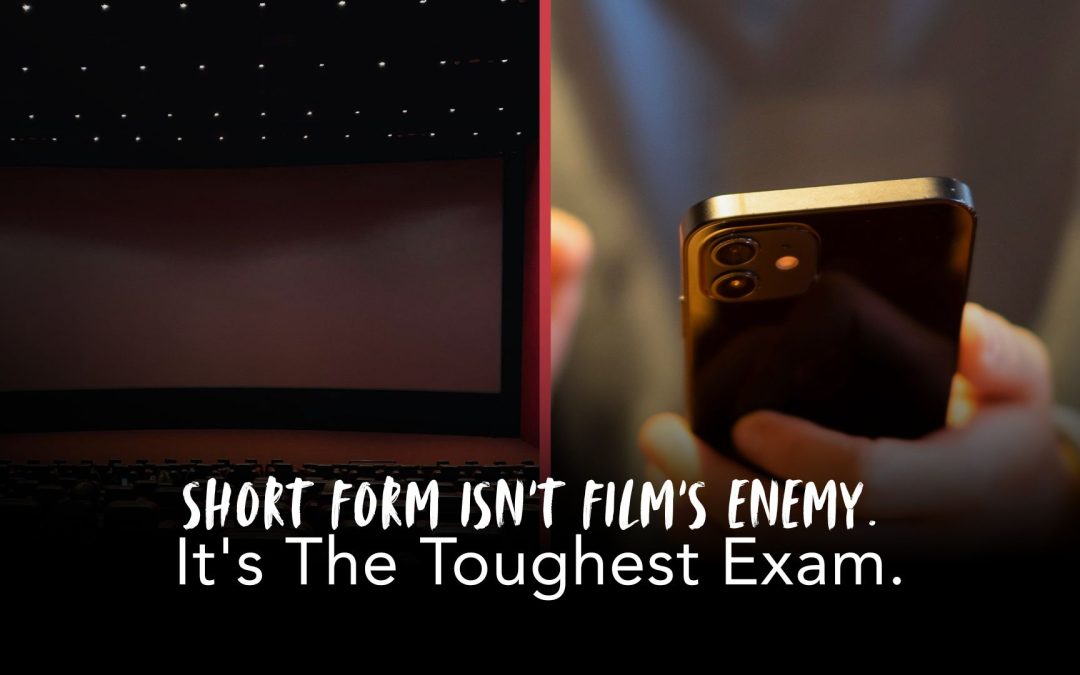
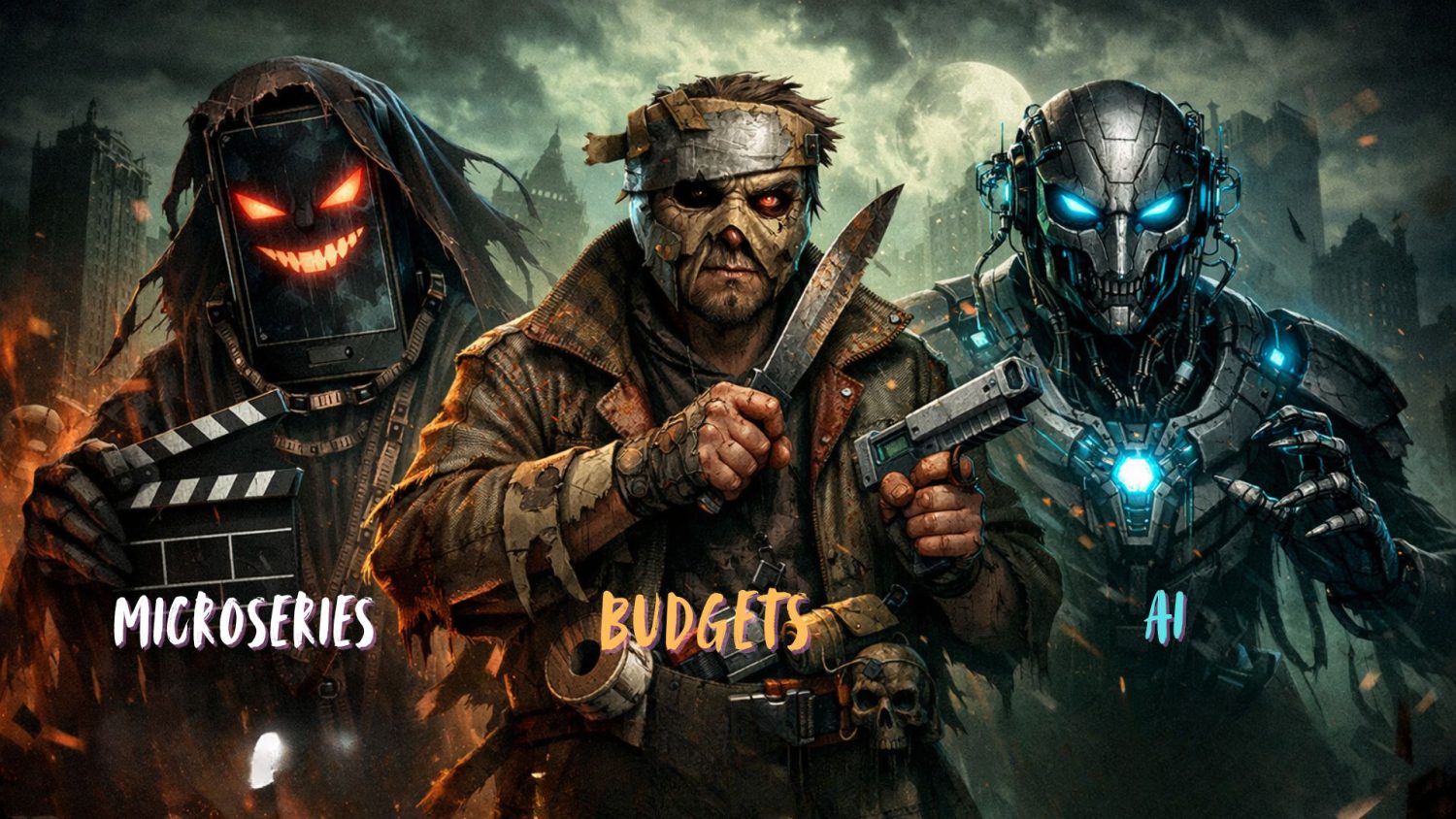
The same conversation keeps coming up at every market, every festival, every industry roundtable, almost always in a defeated tone: our content just isn’t landing anymore. Theaters are emptying out, platforms want something else. The usual suspects are already lined up: short-form video that trained audiences to expect less, budgets that never stretch far enough, and now AI, threatening to make everything faster and cheaper. Three convenient scapegoats — none of which force us to look in the mirror.
At Studio AYMAC, we think that read is comfortable, but wrong. As long as the industry keeps arguing with its scapegoats, it will keep putting off the real conversation: how we think about content, and where we place its reach to audiences within the life of a project.
The Usual Suspects Don’t Explain the Problem
Vertical video didn’t make audiences shallow. Those same viewers memorize, save, and share short pieces that say something true, and they still pack theatres when a screening turns into an event. What they stopped tolerating is effort without payoff: attention didn’t disappear, it got pickier, and now it wants proof before it commits.
Blaming the budget doesn’t hold up either. Low-budget projects find their audience because they know exactly what they are and who they’re for, while big-budget productions vanish without a trace because they never figured that out. Money amplifies clarity when it’s already there; it can’t replace it when it’s missing.
And AI doesn’t decide what’s worth watching. It can speed up processes, cut costs, and multiply versions. But the reason someone chooses a piece of work is still what it’s always been: feeling that there’s a real person behind it, with something true to say.
The Question That Actually Matters
If short form is auditing anything, it isn’t runtime — it’s clarity. A story now has seconds to prove it knows what it is. That doesn’t replace film or television; it tests them. A piece that works in sixty seconds and one that needs two hours share the same core: both know exactly what they want the audience to feel. Length is a creative decision, not a surrender to the algorithm.
The Real Enemy Within
But inside the industry there’s a belief more damaging than any format: that distribution and sales are the dirty side of the craft. Thinking about the audience during development, the logic goes, corrupts the work. Talking about distribution, audiences, and the market is treated as selling out.
That hierarchy — create first, figure out the selling later — is exactly what leaves finished work with no one waiting for it. Distribution is part of what a work is, not paperwork that shows up afterward. Who it’s for, how it reaches that person, what formats it can live in without losing itself: those aren’t business questions muddying up the creative process. They’re creative questions that decide whether the process goes anywhere.
What You Can Start Doing With Your Work Today
Thinking this way changes real decisions. If you have a project in development, these four practices can change where it ends up:
1. Put your premise through the 60-second test. Tell your story in one minute: on camera, in writing, whatever works. If it doesn’t survive the brevity, the premise isn’t fully worked out yet
— The format isn’t to blame.
Better to find that out now than in the final cut.
2. Test before you go all in. A short piece drawn from your premise, published and tracked, tells you more about your connection with an audience than months of guesswork. Don’t think of it as the final product
— Think of it as a check on clarity and real interest.
3. Write down who’s waiting for it. «People will like it» doesn’t cut it
— you need specific audiences, comparable work they already consume, and the channels where they spend their time.
If you can’t write that page yet, what you have isn’t an audience. It’s a hope.
4. Design your work’s afterlife from day one, not at the end.
What formats and windows can this story live in without losing itself
— theatrical, streaming, short-form, spin-offs? Ask that question early, and it multiplies where the work can go; ask it late, and you’re just recycling leftovers.
The Point We’re Making
This industry’s content didn’t stop landing because of vertical video, budgets, or AI. When a piece of work can’t find an audience, the reason usually goes back earlier: to how it was conceived, and to the place — almost always an afterthought, almost always too late — given to how it would actually reach people.
Short form didn’t come to shrink stories down: it came to strip away the hiding places for ones that never knew what they were. And distribution was never art’s enemy — it’s the reason a work gets to exist for someone.
Got a story that only works in vertical?
That’s exactly what we’re looking for at Studio AYMAC: mobile-first projects with their own authentic language.
Write to us today. We want to produce it with you!
Comentarios recientes