
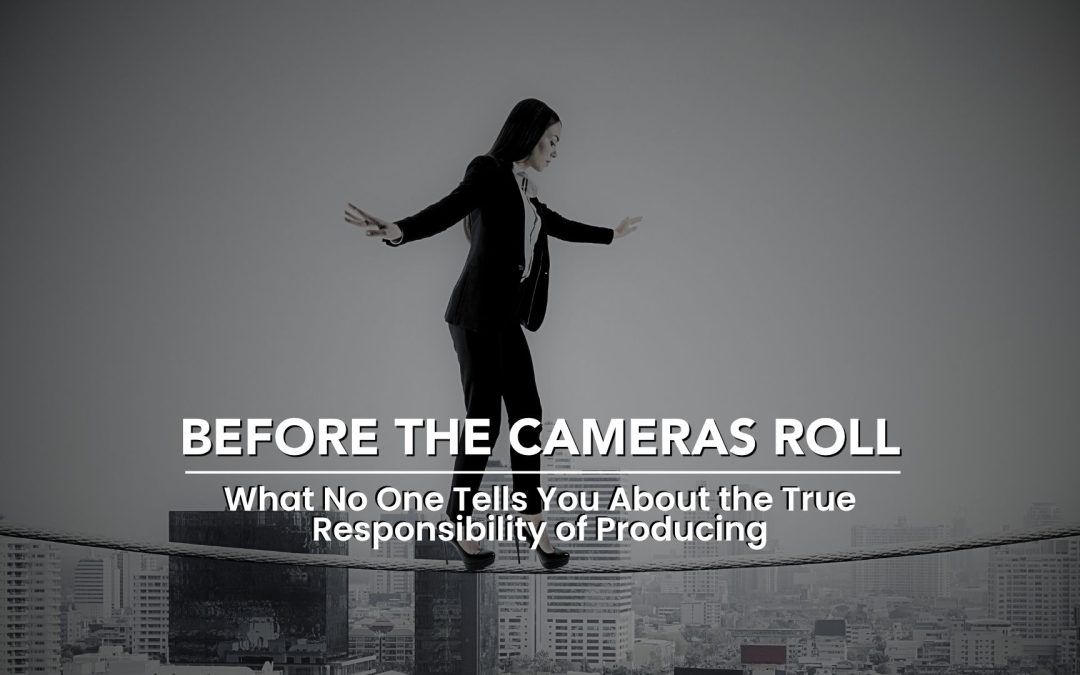
A producer who starts shooting without a safety plan isn’t «optimizing resources.» They are gambling—with both finances and human lives—on a scale that often exceeds their ability to recover.
There is a side of production that is frequently overlooked precisely because it doesn’t show up on screen: real-world risk management. During development, the conversation is all about the budget, the narrative, the crew, and the execution. Everything seems to move within a controlled framework where every decision is logical and every resource is allocated. The problem is that this balance assumes something that rarely holds true: that the shoot will go exactly as planned. And in production, the best-laid plans often go awry.
A film set is not a controlled environment. It is a machine in constant motion. High-pressure technical crews, shifting conditions, time constraints, and decisions made with incomplete information mean that risk isn’t a glitch—it’s a feature. Therefore, the difference between a rock-solid project and a vulnerable one isn’t about avoiding problems; it’s about how prepared you are to face them without the whole thing collapsing.\
When that preparation is missing, the first hit is financial: a stalled shoot means burning through cash without generating any value. In mid-scale Latin American productions, this can mean tens of thousands of dollars per day. But reducing the conversation to money is missing the forest for the trees. The critical point is what happens when that risk directly affects the people making the project possible.
The Great Unknowns
On many sets—especially within the Colombian context—there are things that are simply left hanging::
- Who is actually in charge of the space?
- Who is liable for an incident?
- What happens in the «golden minutes» of an emergency?
This isn’t necessarily a budget issue. It’s about decisions that get kicked down the road because they aren’t «visible» until something goes wrong.
The Bare Minimum (That Hardly Ever Happens)
We aren’t talking about Hollywood-level blockbusters here. We’re talking about basic decisions that change the DNA of a shoot.
Access Control
It’s common for no one to be assigned the task of monitoring who enters, what moves, and where the physical hazards are. Solving this doesn’t require hiring private security; it requires designating one specific person as the «Perimeter Lead» during the shoot. That person isn’t just «lending a hand.» They are fulfilling a vital role in the system.
Realistic First Aid
Any shoot with more than ten people working for several hours should, at the very least, have a fully stocked trauma kit and someone on the crew with basic first aid training. It’s not about having a full-time medic on the payroll—which is often budget-prohibitive—it’s about having someone who knows what to do until the cavalry arrives.
In Colombia, this training is more accessible than people think. Institutions like the Red Cross, SENA, and local Health Secretariats offer first aid courses and «First Responder» programs, often for free or at a nominal cost. Some local governments even offer open-to-the-community workshops, allowing small crews to get certified without breaking the bank.
The cost of training is low. The cost of negligence cannot be measured in dollars alone.
For further information on filming safety protocols and risk management, here are some useful resources:
Training in Colombia
Colombian Red Cross — first aid and First Responder courses, available free of charge or at low cost.
SENA — training in occupational health and safety, available via an online platform.
International safety standards on set
Find information that can serve as a guide for creating risk management plans at:
Safe + Secure Films — safety protocols for audiovisual productions, with downloadable guides tailored to different filming contexts. https://safeandsecure.film/
Committee to Protect Journalists (CPJ) — safety protocols for fieldwork, applicable to documentary productions and filming in high-risk areas.
A Protocol That Actually Works
You don’t need a forty-page manual. You need clarity before the first «Action!» These are the minimum questions that must have an answer:
- Where is the nearest hospital/ER?
- Who on the crew is first-aid certified?
- Where exactly is the medical kit?
- Who is the point person for emergency decisions, and who will accompany the injured party?
If these aren’t defined, you don’t have a protocol—you have a wish list.
The Most Common Mistake: Thinking Insurance is the Starting Line
Risk management doesn’t start with the fine print of an insurance policy. It starts with pre-production decisions: who holds which role, what information the crew has, and how you pivot when things fail. That doesn’t have a fixed price tag; it has a cost of attention and planning.
That said, it’s also a mistake to assume insurance is out of reach. Often, it’s more affordable than you’d think. It is possible to cover a crew with occupational accident insurance—beyond the standard mandatory ARL—for rates as low as $15,000 COP (approx. $4 USD) per person per month. This doesn’t eliminate the risk, but it significantly reduces the exposure for both the project and the producer.
The Pre-Set Checklist (Adapted for Colombia)
Before rolling, the following should be clear—and visible on the Call Sheet:
- Is there a designated person for access and perimeter control?
- Does someone on-site have basic first aid training?
- Is the medical kit fully stocked and accessible?
- Has the nearest medical center been identified?
- Does the crew know the emergency «chain of command»?
- Was a tech scout/location walk-through performed?
- Are emergency numbers posted and visible to everyone?
If any of these questions go unanswered, the project isn’t ready to roll.
Producing is defining the conditions under which every decision happens, and how protected the system is when the inevitable happens. Because when a project fails, it’s rarely for one single reason. It’s because of everything that was known… but was never turned into a production decision.
Comentarios recientes