
For the past two years, the film and television industry has spent a lot of energy arguing over whether artificial intelligence will replace creative professionals. It’s a tired question by now. It’s been answered a thousand different ways, almost always landing on the same lukewarm conclusion: no, technology is just a tool, humans will still be needed. The flip side of that conversation — which prompts work best, which model to use for which task — is just as worn out. Both discussions, however legitimate, have stopped saying anything new. The real conversation is happening somewhere else.
That conversation surfaced with real force at international markets — BAM, Cannes, Berlin, Series Mania, and the rest of the European and Latin American circuit — and it reframes the whole debate: if every producer, director, and studio ends up with access to the same AI tools, where does the competitive edge actually come from?
The answer that’s starting to take hold, almost like a quiet consensus among the people who produce, finance, and distribute content, has nothing to do with technology. It comes down to judgment.

From knowing how to make it, to knowing what’s worth making
For a long time, what separated one creative from another was execution. Knowing how to shoot with technical polish, how to edit with precision, how to write with real craft — those were rare skills, and rarity was the filter that decided who got to produce content and who didn’t. AI broke that filter. Today, anyone with the right tools can generate a polished image, draft a competent script, or edit a video to a technical standard that used to take years to reach.
That doesn’t mean everyone suddenly became creative overnight, as some like to believe. It means something more specific: execution stopped being what separates one project from another. And once execution stops being scarce, value shifts to whatever is still scarce — the ability to pay close attention, to decide what’s actually worth telling, to connect ideas nobody else connected, to hold onto a distinct point of view, and to build a coherent story around all of it. None of that comes from a tool. It comes from someone who has spent years building their own judgment.
Where Studio AYMAC stands
At Studio AYMAC, we think this is the conversation the industry should be having, instead of continuing to debate whether or not to use AI. Our position is simple: AI democratized execution, not judgment. It can speed up a creative process in real ways — cutting down preproduction time, generating visual variations, automating work that used to eat up weeks — but it can’t decide what’s worth making. That decision is, and will remain, deeply human.
This points to what we believe is the real competitive advantage of the next few years: it won’t be about producing faster, it will be about developing sharper judgment. The studios and creatives who understand this before everyone else will hold onto an edge that no tool, however advanced, can take from them.
What actually changes when judgment becomes the differentiator
This shift isn’t just conceptual — it plays out in very concrete ways, in how brands, films, campaigns, and creative companies get built. It changes who gets hired, because technical mastery of a tool is no longer enough when that mastery is available to almost anyone. It changes who gets trusted to lead a project, because that trust now depends less on execution and more on making the right call at the right moment. And it changes what gets taught in a writer’s room, on set, or in a post-production suite, where technical training is giving way to something harder to teach: a trained eye, an editorial instinct, a distinct way of seeing the world.
Ten years ago, the industry admired people who could execute with skill. Today, it’s starting to admire people who can decide with clarity. That shift may sound subtle, but it’s redefining what it means to be valuable in a creative industry.
The idea we stand behind
For years, we confused creativity with execution, partly because execution was hard and, therefore, rare. AI dismantled that confusion by making execution accessible to almost anyone. What’s left once you strip away that technical layer is the question that actually defines a creative professional: the ability to ask better questions, connect general ideas, build a point of view, and — above all — decide what deserves to exist.
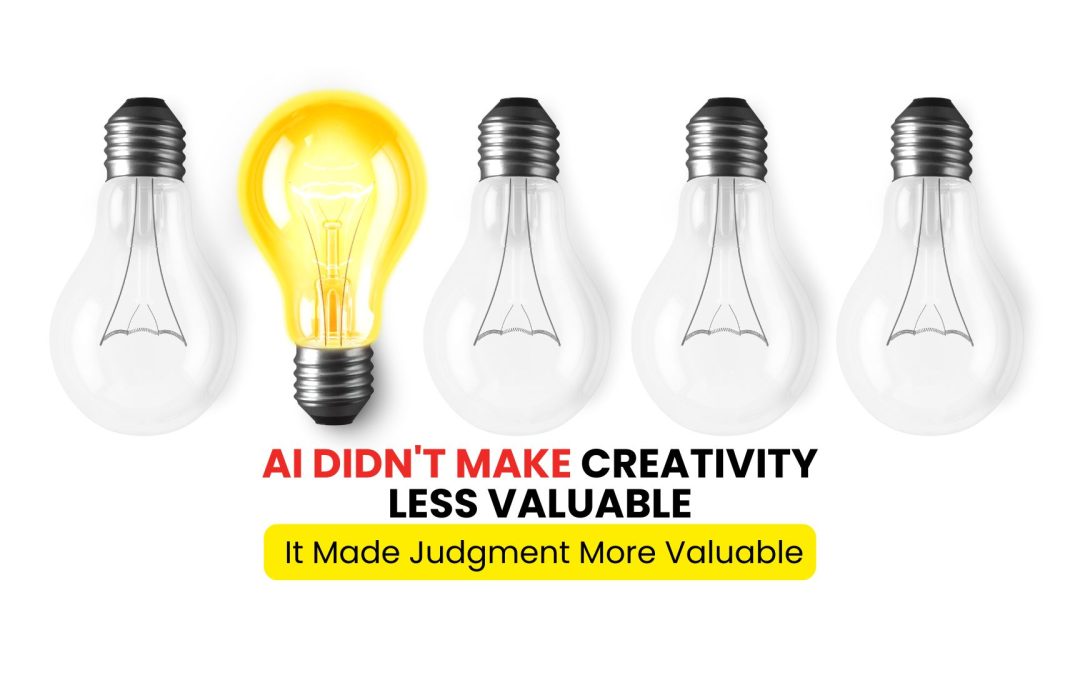
That’s why, at Studio AYMAC, we don’t think AI is replacing creatives. We think it’s forcing them to go back to the one thing they should never have stopped doing: thinking. If we had to boil the entire conversation the industry should be having down to one idea, it would be this: AI didn’t make creativity less valuable. It made judgment far more valuable. The real value was never in the tool. It was always in the person who knew what to do with it.
Comentarios recientes